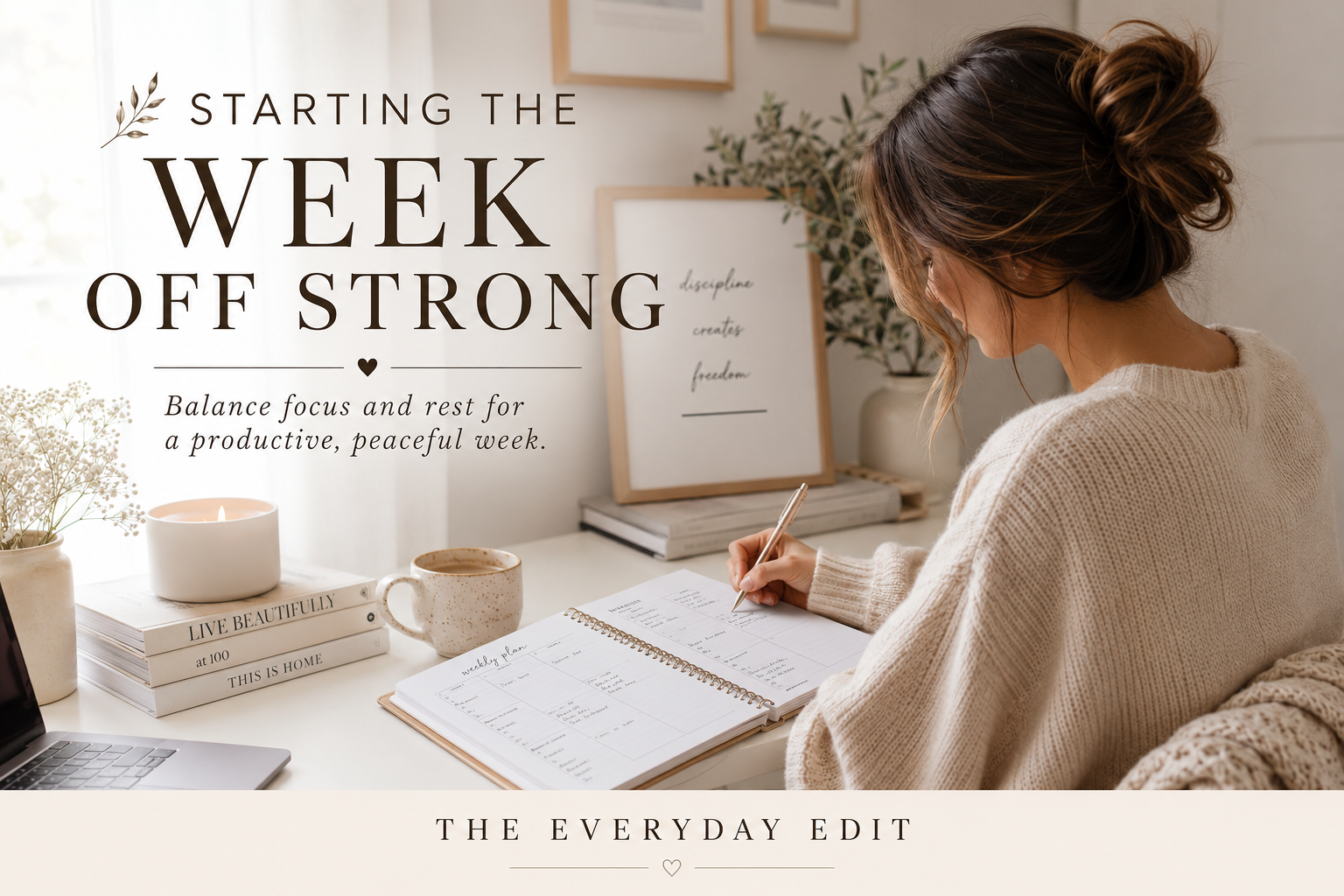
🌿 Starting the Week Off Strong: How to Balance Focus, Rest, and Intentional Planning
There is something so hopeful about a fresh week. A new Monday can feel like a blank page, a quiet invitation to reset your mind, reorder your priorities, and step into your days with a little more peace and purpose. But starting the week off strong does not mean filling every empty space with more tasks, more pressure, and more hustle. Sometimes, the strongest weeks are the ones where we plan for both deep focus and real rest. ✨
A meaningful weekly reset is not about becoming a machine. It is about becoming more intentional. It is about looking at your time honestly and asking, “What actually matters this week?” When we give our best energy to the right things, while also protecting space to breathe, recover, and be present, we create a rhythm that feels both productive and peaceful.
As The Everyday Edit philosophy reminds us, simple intentional choices can shape a beautiful life. A strong week is not built by doing everything. It is built by choosing wisely, focusing deeply, resting fully, and remembering that your worth is not measured by how much you can squeeze into a calendar. 🌸
“The key is not to prioritize what’s on your schedule, but to schedule your priorities.” — Stephen Covey
1. Begin With a Gentle Weekly Reset 📝
Before you start blocking off your time, take a few quiet minutes to look at the week ahead. This does not have to be complicated. Open your planner, notebook, calendar, or phone and simply write down everything that is floating around in your mind. Appointments, work deadlines, errands, family commitments, workouts, meals, chores, personal goals, and anything that has been quietly taking up mental space.
This practice helps you move from mental clutter to calm clarity. So often, we feel overwhelmed not because the week is impossible, but because everything is living in our heads at the same time. A weekly reset gives those thoughts a home. It lets you see what is real, what is urgent, what can wait, and what does not need to be carried at all.
Once everything is written down, gently sort your list into categories. What must be done this week? What would be nice to do? What can be delegated, delayed, simplified, or removed? This is where intentional living begins. You are not just reacting to the week — you are thoughtfully shaping it. 🌿
A strong weekly planning routine for busy women, working moms, entrepreneurs, students, or anyone managing a full life should include both practical structure and emotional breathing room. You are not planning a perfect week. You are creating a realistic rhythm that supports your actual life.
2. Choose Your Top Priorities Before Your To-Do List ✅
A to-do list can be helpful, but it can also become a place where everything feels equally important. That is why choosing your top priorities first is so powerful. Before you write twenty tasks, choose three main things that would make the week feel meaningful, successful, or lighter.
These priorities might be work-related, like finishing a project, preparing for a meeting, or catching up on emails. They might be personal, like getting back into your workout routine, planning meals, spending intentional time with family, or finally booking an appointment you have been avoiding. They might also be emotional or spiritual, like slowing down, praying more consistently, journaling, or creating a calmer morning routine. 🤍
When you choose priorities before tasks, you give your week a clear direction. You are no longer just checking boxes. You are making thoughtful decisions based on what matters most. This helps prevent the common trap of being busy all week but still feeling like nothing important moved forward.
A helpful question to ask is: “By Friday, what would I be grateful I made time for?” That one question can quickly reveal what deserves space in your calendar. It invites you to plan from wisdom instead of pressure.
“Do what you can, with what you have, where you are.” — Theodore Roosevelt
3. Block Time for Deep Focus 🔒
Time blocking is one of the simplest ways to protect your attention. Instead of keeping a long list and hoping everything gets done, you assign specific tasks to specific windows of time. This turns your calendar into a gentle roadmap for your week.
For example, instead of writing “work on project,” you might block Tuesday from 9:00 to 10:30 for focused project work. Instead of writing “clean house,” you might block Saturday morning for a reset hour. Instead of vaguely hoping to exercise, you give your workout a place in the day. Time blocking helps reduce decision fatigue because you are not constantly asking, “What should I do next?” Your plan already gives you direction.
The key is to block your best energy for your most important work. If your mind is sharpest in the morning, protect that time for tasks that require thinking, creativity, writing, planning, problem-solving, or deep concentration. Save lower-energy tasks, like admin, tidying, errands, or simple emails, for moments when your focus naturally dips.
This is especially helpful for anyone trying to start the week productive without feeling overwhelmed. A well-planned focus block can help you accomplish more in ninety intentional minutes than in an entire distracted afternoon. But the goal is not to control every second. The goal is to create enough structure that your attention has somewhere peaceful to land. ✨
4. Schedule Rest Like It Matters — Because It Does 🌙
Rest should not be the leftover piece of your week. It should be part of the plan. Many people block off work, errands, meetings, and obligations, but leave rest to chance. Then, when life gets busy, rest disappears first. The problem is that a life without rest eventually becomes a life without joy, clarity, or energy.
Blocking time for rest can look different depending on your season. It might be an early bedtime, a slow Sunday evening, a no-phone morning, a walk outside, quiet time with coffee, reading, prayer, a bath, or simply leaving one evening unscheduled. Rest does not always mean doing nothing. Sometimes rest means doing something that restores you instead of drains you.
This is where a positive philosophical mindset becomes so important. A balanced life is not built only through achievement. It is built through rhythm. Nature itself teaches us this: seasons of growth, seasons of stillness, sunrise and sunset, work and recovery. We were never meant to live in constant output mode. 🌿
When you schedule rest, you are not being lazy. You are being wise. You are protecting the energy that allows you to show up with love, patience, creativity, and presence. A strong week needs focus blocks, but it also needs soft places to land.
“Almost everything will work again if you unplug it for a few minutes, including you.” — Anne Lamott
5. Build in Margin for Real Life ☁️
One of the biggest mistakes we make when planning the week is pretending everything will go perfectly. We plan back-to-back blocks, fill every open space, and assume we will have endless energy. Then one appointment runs late, one child needs extra help, one work task takes longer than expected, and suddenly the whole plan feels broken.
Margin is the space between your plans. It is the breathing room that allows life to happen without everything falling apart. Building margin into your week might mean leaving 15 minutes between meetings, keeping one evening open, planning simpler meals on busy nights, or giving yourself extra time for transitions.
A realistic weekly planning routine should include space for the unexpected. This does not make your plan weaker. It makes it stronger. A flexible plan is easier to return to when things shift. A packed plan often collapses the moment life gets messy.
Margin also creates emotional peace. When every minute is spoken for, your nervous system feels it. But when there is room to breathe, your week starts to feel more human. You can move through your days with less rushing and more presence.
6. Balance Productive Blocks With Restorative Blocks ⚖️
A beautiful week has both productive blocks and restorative blocks. Productive blocks help you move forward. Restorative blocks help you stay well. Both matter. One without the other often leads to either stagnation or burnout.
Productive blocks might include focused work, budgeting, content creation, studying, cleaning, meal prep, business tasks, or home projects. These are the blocks that help you create progress and reduce future stress. Restorative blocks might include sleep, prayer, journaling, family time, movement, reading, nature, hobbies, or quiet evenings. These are the blocks that help you return to yourself.
Try looking at your calendar and asking, “Does this week have enough focus?” Then ask, “Does this week have enough recovery?” That simple check-in can help you see whether your schedule is balanced or whether you are leaning too heavily toward pressure.
The goal is not to divide your life perfectly. The goal is to create a rhythm that feels sustainable. A week that makes room for progress and peace is far more powerful than a week packed with activity but empty of rest. 🌸
7. End the Week With Reflection, Not Judgment 🤍
A strong week does not require a perfect ending. At the end of the week, take a few minutes to reflect without criticizing yourself. Ask what went well. Ask what felt heavy. Ask what needs to change next week. Ask what you are grateful for.
Reflection helps you learn from your life instead of simply rushing through it. Maybe you planned too much. Maybe your focus blocks worked beautifully. Maybe you need more rest next week. Maybe you realized that a certain task is not as important as you thought. These little observations are how you begin to design a life that fits you better.
It is important to approach this practice with grace. Your planner is not a report card. Your calendar is not a measure of your worth. It is simply a tool to help you live with more intention. Some weeks will be productive. Some weeks will be tender. Some weeks will require more flexibility than focus. That is okay.
Starting the week off strong is not about forcing your life into a perfect system. It is about making thoughtful choices, protecting what matters, and creating space for both ambition and peace. 🌿
Final Thoughts: A Strong Week Is a Balanced Week ✨
The best kind of week is not the busiest one. It is the one where your time reflects your values. It is the one where you make space for meaningful work, quiet rest, daily responsibilities, and the people and practices that keep you grounded.
When you block time for focus, you honour your goals. When you block time for rest, you honour your humanity. Together, they create a beautiful rhythm — one that helps you live with clarity, peace, and purpose.
So before the week begins, take a breath. Look at your calendar. Choose what matters. Protect your focus. Schedule your rest. Leave room for grace.
Small, intentional edits can change the way your whole week feels. 🌸
Product Recommendations 🛒
1. The Time-Block Planner by Cal Newport
A helpful planner for anyone who wants to organize their day into clear focus blocks and reduce scattered task-switching.
Shop on Amazon
2. EooCoo Visual Pomodoro Timer
A simple desk timer that can help you work in focused sessions and remember to take intentional breaks.
Shop on Amazon
Check out our easy to use EverydayEdit Planning tool! ~Free!
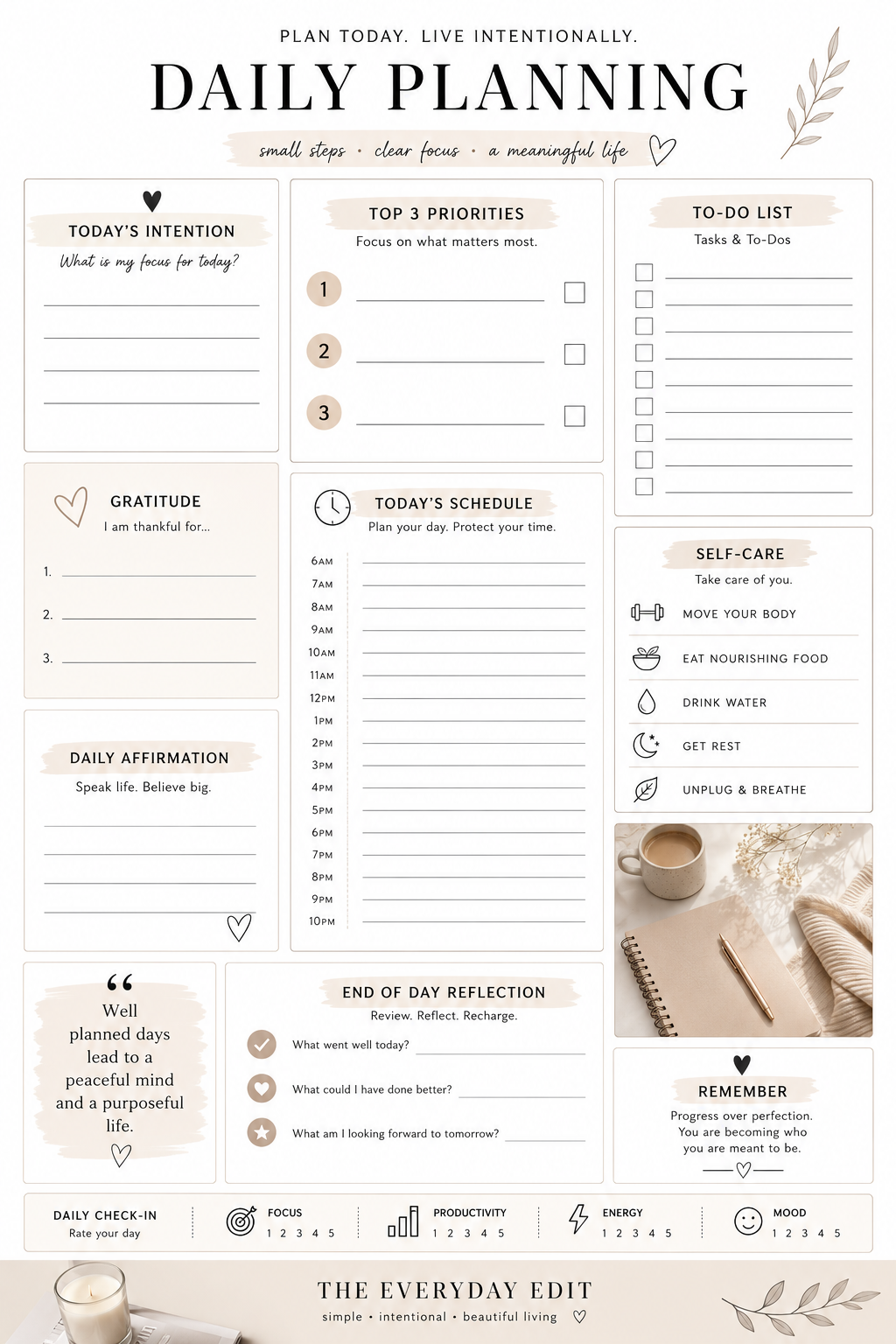
Free Template!
Bring more calm, clarity, and intention into your day with the Everyday Edit Daily Planning Printable.
This beautifully designed daily planner helps you organize your priorities, schedule your time, track your to-do list, and reflect on your day — all in one easy-to-use page. With soft neutral tones, clean sections, and an elegant Everyday Edit aesthetic, it’s perfect for printing at home, adding to a binder, or using digitally on a tablet.
Inside, you’ll find space for your daily intention, top 3 priorities, to-do list, gratitude, affirmation, schedule, self-care reminders, end-of-day reflection, and a simple daily check-in for focus, productivity, energy, and mood.
Perfect for anyone who wants to feel more organized, intentional, and grounded throughout the day.